Layer 1 of 5, counting up from the mattress
Mattress Protector
A protector is a fitted skin that goes straight onto the mattress and stays there. Its whole job is to stop liquid, dust and body oil from reaching foam or ticking you cannot wash. In a linen closet it is the item people forget exists until the day it earns its keep.
Where it sits
Fit
Does it fit?
A protector has to clear the mattress alone, so it is the easiest fit in the stack and the one people still get wrong. It goes under the topper, not over it, unless you are protecting the topper instead of the mattress. If you own both and only one protector, decide which surface you are actually trying to keep dry, because a protector only guards what is underneath it. Listings in this catalog quote their range in two ways: a single ceiling such as fitting up to 18 in, or a span such as 8 to 21 in. A span is the more useful number, because the elastic has a floor as well as a ceiling, and a thin mattress inside a tall pocket rides up in the night.
- Stated ceilings in this catalog run from 14 in to 21 in of mattress thickness.
- Several listings quote a span rather than a ceiling, including 6 to 18 in and 8 to 21 in.
- A protector adds so little height that this site treats it as a fixed quarter inch when adding up the stack.
Heat
Does it sleep hot?
A waterproof protector is a film with fabric on top. Film does not pass air the way a woven sheet does, and that is the honest trade for keeping a mattress dry. Sellers answer this with surface constructions: a knit face of viscose from bamboo, or a spacer mesh they call 3D air fabric. Those change how the surface feels against a hand and how quickly the top layer dries out. They do not remove the film underneath. If you sleep hot and you are deciding whether to run a protector at all, the film is the thing you are deciding about, not the face fabric.
Words sellers use on this layer
- breathable
- noiseless
- cooling
- 3D air fabric
None of those carries a unit or a test method. They describe an intention, and this site quotes them as seller language wherever they appear on a listing.
Wash
How often does it go in?
- How often
- Every two months, and immediately after any spill.
- Watch for
- Crackle. A protector that has started to sound like a chip bag has a film that is breaking up, and a broken film is not waterproof.
- Stiff patches, which usually mean the laminate has been through a dryer hotter than it was built for.
- Elastic that no longer snaps back, so the corners lift and the sheet above it lifts too.
- Replace when
- When it crackles, when a spill reaches the mattress through it, or when the corners no longer stay put. There is no useful mileage figure here, because what ends a protector is heat and spills, not nights slept.
The whole schedule, with every prohibition in one place, is on Care Calendar.
DisclosureLinks to Amazon on this page are affiliate links. If you buy through one, this site may earn a commission at no extra cost to you. It does not change what is written here, and no seller has paid for a place in any list.
One concrete example
Keeping the mattress dry without adding a plastic sound is what this category has to do, and this is the item in it whose listing states the most about doing that. The rest of the 12 are on Mattress Protectors.
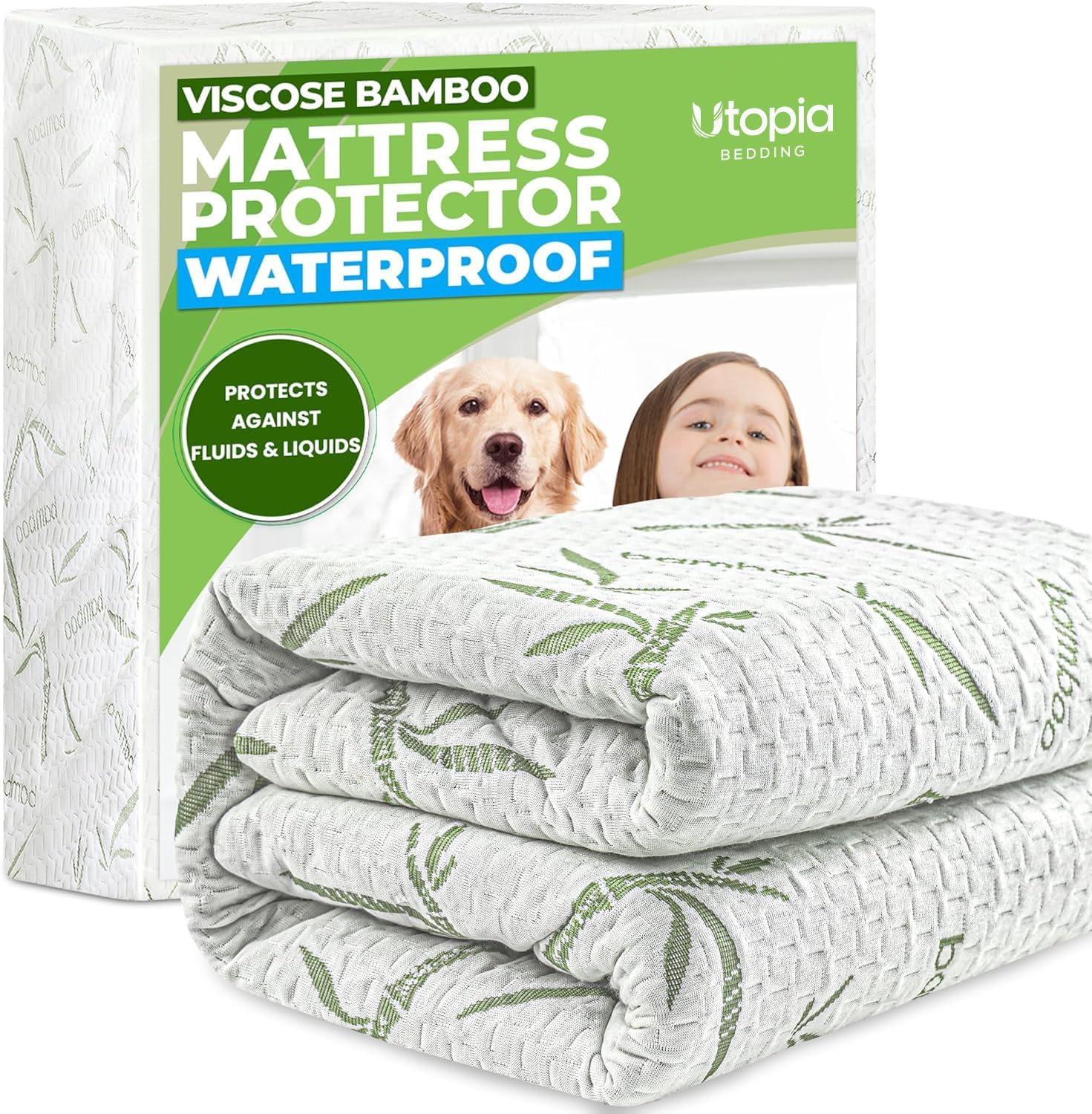
Utopia Bedding Bamboo Waterproof Protector, Queen
Only protector naming its fiber and a pocket depth
The job of a protector is to keep the mattress dry without turning the bed into something that rustles, and this one states waterproof, noiseless and a depth all three. Several others do too. What is not shared is the combination of a named fiber with an actual pocket depth rather than a mattress ceiling.
The listing statesviscose from bamboo · 17 in
Check it on AmazonWhat this layer is usually made of
- Rayon and Viscose from Bamboo
This is rayon. Bamboo is the plant the cellulose was taken from, and the fabric that results is a regenerated cellulose fiber, not bamboo in any structural sense. The FTC has been explicit that textiles made through the viscose process have to be labeled as rayon or as viscose, with bamboo mentioned only as the source of the raw material. Listings that say bamboo alone are not describing what is in the box.
- Microfiber
Microfiber is polyester, extruded as filaments fine enough that the fabric behaves differently from ordinary polyester cloth. The word describes the fineness of the fiber, not the fiber itself, so a microfiber sheet is a polyester sheet with a specific manufacturing spec. Listings use the texture word far more often than they use the fiber word, and both are accurate.
- Cotton Percale
Percale is cotton in a plain weave: one thread over, one thread under, evenly, all the way across. That is the entire definition. It is not a quality tier and it is not a brand, and any cotton fabric woven that way can be sold under the word. What the structure gives you is a matte surface with no sheen and a hand that people describe as crisp, which is really just a fabric with nothing floating loose on the face of it.
Where this comes from
Disclosure, againAs an Amazon Associate this site earns from qualifying purchases. Product details come from the seller listings and are described as claims, not as findings. Nothing here has been tested.